Background
Identity is something we often take for granted in a fast-paced world where everyone faces their own unique set of challenges. It is frequently overlooked as something trivial or secondary. Yet, in an increasingly monotonous world, identity is what makes us feel distinct, grounded, and valued.
Moving to a new environment whether it’s a different city, state, or an entirely new country is often framed as an exciting milestone. A fresh start. New opportunities. New people. For many students, this journey begins with university, studying abroad, or learning how to stand on our own two feet for the first time.
Yet beneath the excitement lies a quieter, harsher reality that isn’t spoken about enough: the mental and emotional adjustment. Leaving behind familiar routines, support systems, and a sense of belonging can be deeply destabilising. Even when the move is something we have always wanted, the transition does not spare anyone.
At its core, this transition raises a confronting question, identity.
Who am I when familiarity is stripped away?
Who am I becoming?
And, more importantly, who do I choose to become?

Personal Experience
The people who sent me off at the airport are no longer in my life.
At the time, that moment felt full of certainty, tearful goodbyes, embraces, photographs, and promises to stay in touch. I believed distance would be the hardest obstacle to overcome. What I didn’t realise was that moving would demand far more than physical separation. It would require me to confront who I was becoming, what parts of myself would be reshaped, and which values I would need to protect.
As time passed, familiar support systems quietly fell away. Relationships changed. Some ended. Words spoken by people I once trusted made me more cautious about who I allowed close. Loneliness, pressure, and self-doubt began to compound, and I was left with little choice but to adapt.
There were periods when the challenges felt relentless. I became more reserved, more self-reliant, and emotionally guarded in ways I had never been before. In learning how to survive independently, I also lost sight of myself at times operating on routines rather than clarity, resilience rather than understanding.
When I eventually spoke to my mother, she said something that stayed with me: she could sense that I wasn’t the same person anymore to the point where she could barely recognise me. That moment forced me to pause. The change had been so gradual that I hadn’t fully acknowledged how deeply it had affected me.
What I came to understand was this: the challenges didn’t break me, but they did reshape me. They forced me to grow faster, mature differently, and view the world through a sharper, more disciplined lens. I learned to feel deeply without letting my emotions dictate my decisions. I learned to hold onto what was true to me, even as change became inevitable.
Impact
Before all of this, I was a strong finance student drawn to numbers because they are structured, logical, and grounded in clarity. There is comfort in systems that can be measured, forecasted, and explained. Finance taught me discipline, objectivity, and how to think in terms of outcomes.
However, these experiences expanded how I view those numbers. I began to recognise that behind every data point, decision, and market movement is a human being navigating pressure, emotion, and uncertainty. This realisation sparked a deeper professional interest in psychology not as a departure from finance, but as a complementary lens.
Understanding behaviour, resilience, and decision-making under stress strengthened how I approach finance. It reminded me that numbers reflect people before they reflect performance and that human complexity often explains what data alone cannot.
Reflection
Staying grounded does not mean suppressing or ignoring your feelings. It means acknowledging them, processing them, and choosing not to let them overwhelm your direction or values. Who you become will always be a reflection of the choices you make, especially when circumstances test you the most. Growth in unfamiliar environments often demands emotional restraint alongside vulnerability.
Change spares no one. It strips parts of you some painfully, some necessarily. The challenge is not to resist change entirely, but to ensure it does not erase the values and identity you choose to stand by; it does not erase you.
If you are navigating a new environment and finding it harder than expected, know this: struggle does not mean failure. Growth is never easy. It takes many forms of endurance, vulnerability, and more often than not, grief. What matters, especially for students, is remaining grounded while acknowledging the winds of change they are bound to face as life continues.
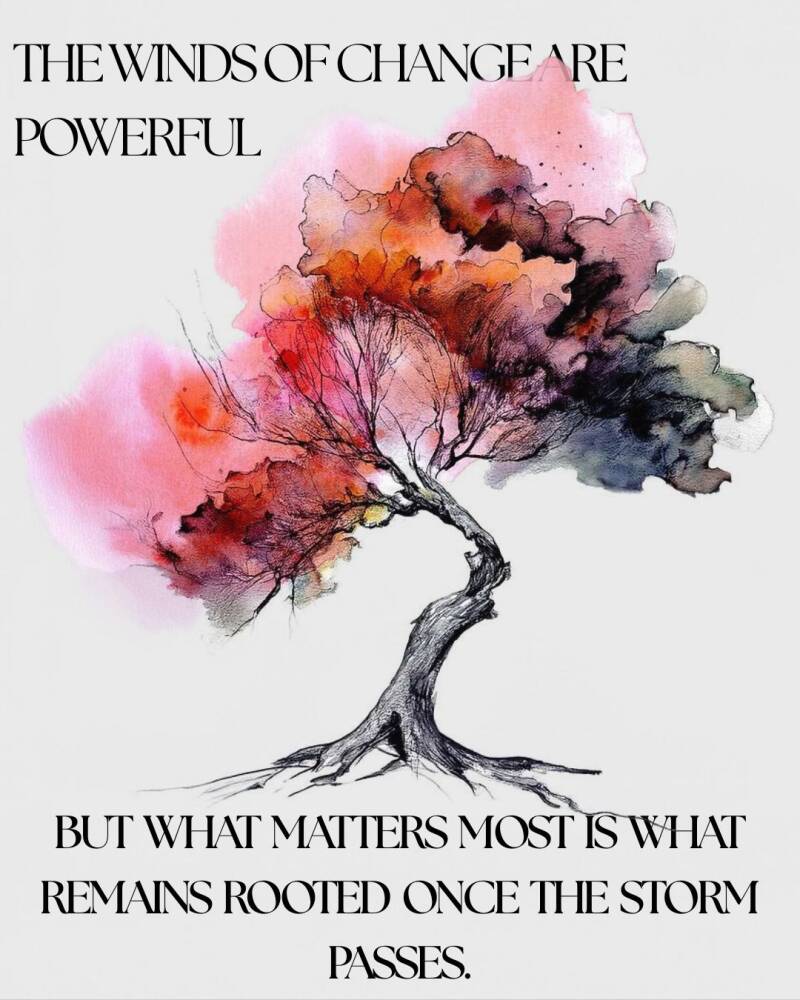
The winds of change are powerful but what matters most is what remains rooted once the storm passes.
Raiman Amir
Raiman Amir is an international student and writer passionate about mental health, personal growth, and storytelling. Through his blog, he shares reflections on identity, resilience, and navigating life transitions.